|
||||||||||||||||||||||||||||||||||||
|
|
Declaration of Independence
Proclamation of the Nagorno Karabakh Republic
Declares The Nagorno Karabakh Republic within the current boundaries of the NK autonomous region and the adjacent Shahumian district, the NKR The Nagorno Karabakh Republic, basing itself on the authority given to republics by the constitution and legislation of the USSR, reserves the right to decide independently its legal status as a state on the basis of political consultations and negotiations with the leadership of other countries and republics. Prior to the acceptance of the constitution and laws of the NKR, the constitution and legislation of the USSR, as well as other existing laws shall be in effect on the territory of the NKR unless they contradict the purposes and principles of this declaration and the specific nature of the republic. /Signed/ Delegates of all levels participating in the joint
session of the NK regional September 2, 1991 Act on Referendum Conducted
The Central Election Committee on conducting the referendum notes that in accordance with the November 27, 1991 decision of the session of the NKR Soviet of people's deputies and the Temporary Provision on Referendum in the NKR, confirmed by the same session, on December 10, 1991 a referendum was held on the whole territory of Nagorno Karabakh in order to finally determine its status, the forms of state structure and interrelation with other states and commonwealths. On the day of the referendum the whole territory of the Nagorno Karabakh Republic, especially its capital - Stepanakert - was the subject of heavy artillery and rocket shelling by Azerbaijani band formations trying to suppress the voice of the Artsakh people striving for freedom from national oppression. A great number of houses and administrative buildings were destroyed in towns and regions of the republic. 10 people deceased only on the day of the referendum. However, the population of the republic, having overcame the incredible hardships, as a single unity participated in the elections in order to unite voices against the centuries-old tyranny. 108,736 or 82.2 per cent of the total number of 132,328 registered voters participated in the elections. Voters of Azerbaijani nationality - 22,747 persons - did not take part in the referendum, although the CEC (Central Election Committee) made attempts to get in contact with them in order to reach consensus on those issues. The corresponding documents as well as the Temporary Provision on referendum and parliamentary elections in NKR were sent to them in due time. The servicemen of the military base, allocated in Stepanakert, did not participate in the referendum because of political motives. The referendum took place in 70 of the total number of 81 constituencies. In the 10 of 11 constituencies, where the referendum did not take place, Azerbaijani population lived. "Do you agree that the proclaimed Nagorno Karabakh republic be an independent state acting on its own authority to decide forms of co-operation with other states and communities?" 108,615 persons or 99.9 per cent of the total number of voters answered "Yes" and 24 persons or 0.02 per cent answered "No" to the aforementioned question. 95 ballots or 0.09 per cent were recognised invalid. The referendum was conducted in accordance with the international norms as well as the Temporary Provision on Referendum in the NKR. The Central Election Committee has not received any complaints or statements about any breaches. Deputies of the Supreme Soviet of the USSR, Russia and Moscow as well as representatives of different international organisations and foreign states were present at the referendum as observers and made positive comments. Thus, the will of the people of the Nagorno Karabakh Republic to build an independent state became an objective reality. E. Petrossian Declaration on State Independence
The Supreme Soviet of the Nagorno Karabakh Republic
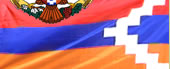
The NKR is an independent state. It has its own national flag, emblem and anthem. The NKR Constitution and laws, as well as international and legal acts regulating respect of human rights and freedoms are in force in the NKR territory. Whole power in the NKR belongs to the people of the Nagorno Karabakh Republic, which realizes its power and will through nationwide referendum or via representative bodies. All the residents of Nagorno Karabakh are citizens of the NKR. The NKR allows double citizenship. The NKR protects its citizens. The NKR guarantees rights and freedoms of all its citizens regardless of their nationality, race and creed. Armed forces, law enforcement and state security bodies are established in the NKR subordinate to supreme authorities to ensure the protection of its citizens and the security the population. The NKR citizens serve in the military on the territory of the NKR. The NKR citizens' military service in other states, as well as presence of foreign armed forces in the NKR territory is realized on the basis of interstate agreements and arrangements. As a subject of international law, the NKR conducts an independent foreign policy, establishes direct relations with other states, and participates in the activities of international organizations. Land, depths, air space, natural, material and spiritual wealth of the NKR is the property of its people. The NKR laws regulate their usage and ownership. The NKR economy is based on the principle of equality of all forms of property. It ensures equal opportunities of full and free participation in the economic life for all citizens of the NKR. The NKR recognizes the priority of human rights, ensures the freedom of speech, conscience, political and social activity and all the other universally recognized civil rights and freedoms. National minorities are under protection by the state. The NKR state structure ensures for national minorities the possibility of a full-fledged participation in political, economic and spiritual life of the Republic. The law prosecutes any national discrimination. The NKR state language is Armenian. The NKR recognizes the national minorities' right for using, without any restrictions, their native language in economic, cultural and educational spheres. This Declaration and General Declaration on Human Rights form the basis of the NKR Constitution and legislation. January 6, 1992
| ||||||||||||||||||||||||||||||||||




























 With the participation of delegates from all levels of councils in a
joint session of peoples deputies of the Nagomo Karabakh (NK) regional
and Shahumian district councils, by the expression of the popular will
supported by a documented referendum, and by the decision taken by the
authorities of the NK autonomous region and the Shahimian district between
1988-91 concerning its freedom, independence, equal rights, and neighborly
relations;
With the participation of delegates from all levels of councils in a
joint session of peoples deputies of the Nagomo Karabakh (NK) regional
and Shahumian district councils, by the expression of the popular will
supported by a documented referendum, and by the decision taken by the
authorities of the NK autonomous region and the Shahimian district between
1988-91 concerning its freedom, independence, equal rights, and neighborly
relations;
